


The Millennials: Confident. Connected. Open to Change.
Generations, like people, have personalities, and Millennials — the American teens and twenty-somethings who are making the passage into adulthood at the start of a new millennium — have begun to forge theirs: confident, self-expressive, liberal, upbeat and open to change.
They are more ethnically and racially diverse than older adults. They’re less religious, less likely to have served in the military, and are on track to become the most educated generation in American history.
Their entry into careers and first jobs has been badly set back by the Great Recession, but they are more upbeat than their elders about their own economic futures as well as about the overall state of the nation.(See chapter 4 in the full report)

The Millennials
They embrace multiple modes of self-expression. Three-quarters have created a profile on a social networking site. One-in-five have posted a video of themselves online. Nearly four-in-ten have a tattoo (and for most who do, one is not enough: about half of those with tattoos have two to five and 18% have six or more). Nearly one-in-four have a piercing in some place other than an earlobe — about six times the share of older adults who’ve done this. But their look-at-me tendencies are not without limits. Most Millennials have placed privacy boundaries on their social media profiles. And 70% say their tattoos are hidden beneath clothing. (See chapters 4 and 7 in the full report)

The Millennials. Connected.
Despite struggling (and often failing) to find jobs in the teeth of a recession, about nine-in-ten either say that they currently have enough money or that they will eventually meet their long-term financial goals. But at the moment, fully 37% of 18- to 29-year-olds are unemployed or out of the workforce, the highest share among this age group in more than three decades. Research shows that young people who graduate from college in a bad economy typically suffer long-term consequences — with effects on their careers and earnings that linger as long as 15 years.1 (See chapter 5 in the full report)
Whether as a by-product of protective parents, the age of terrorism or a media culture that focuses on dangers, they cast a wary eye on human nature. Two-thirds say “you can’t be too careful” when dealing with people. Yet they are less skeptical than their elders of government. More so than other generations, they believe government should do more to solve problems. (See chapter 8 in the full report).
They are the least overtly religious American generation in modern times. One-in-four are unaffiliated with any religion, far more than the share of older adults when they were ages 18 to 29. Yet not belonging does not necessarily mean not believing. Millennials pray about as often as their elders did in their own youth. (See chapter 9 in the full report)

The Millennials. Priorities.
Only about six-in-ten were raised by both parents — a smaller share than was the case with older generations. In weighing their own life priorities, Millennials (like older adults) place parenthood and marriage far above career and financial success. But they aren’t rushing to the altar. Just one-in-five Millennials (21%) are married now, half the share of their parents’ generation at the same stage of life. About a third (34%) are parents, according to the Pew Research survey. We estimate that, in 2006, more than a third of 18 to 29 year old women who gave birth were unmarried. This is a far higher share than was the case in earlier generations.2 (See chapters 2 and 3 in the full report)
Millennials are on course to become the most educated generation in American history, a trend driven largely by the demands of a modern knowledge-based economy, but most likely accelerated in recent years by the millions of 20-somethings enrolling in graduate schools, colleges or community colleges in part because they can’t find a job. Among 18 to 24 year olds a record share — 39.6% — was enrolled in college as of 2008, according to census data. (See chapter 5 in the full report)
They get along well with their parents. Looking back at their teenage years, Millennials report having had fewer spats with mom or dad than older adults say they had with their own parents when they were growing up. And now, hard times have kept a significant share of adult Millennials and their parents under the same roof. About one-in-eight older Millennials (ages 22 and older) say they’ve “boomeranged” back to a parent’s home because of the recession. (See chapters 3 and 5 in the full report)
They respect their elders. A majority say that the older generation is superior to the younger generation when it comes to moral values and work ethic. Also, more than six-in-ten say that families have a responsibility to have an elderly parent come live with them if that parent wants to. By contrast, fewer than four-in-ten adults ages 60 and older agree that this is a family responsibility.
Despite coming of age at a time when the United States has been waging two wars, relatively few Millennials — just 2% of males — are military veterans. At a comparable stage of their life cycle, 6% of Gen Xer men, 13% of Baby Boomer men and 24% of Silent men were veterans. (See chapter 2 in the full report)

The Millennials. Politics.
Politically, Millennials were among Barack Obama’s strongest supporters in 2008, backing him for president by more than a two-to-one ratio (66% to 32%) while older adults were giving just 50% of their votes to the Democratic nominee. This was the largest disparity between younger and older voters recorded in four decades of modern election day exit polling. Moreover, after decades of low voter participation by the young, the turnout gap in 2008 between voters under and over the age of 30 was the smallest it had been since 18- to 20-year-olds were given the right to vote in 1972. (See chapter 8 in the full report)
But the political enthusiasms of Millennials have since cooled — for Obama and his message of change, for the Democratic Party and, quite possibly, for politics itself. About half of Millennials say the president has failed to change the way Washington works, which had been the central promise of his candidacy. Of those who say this, three-in-ten blame Obama himself, while more than half blame his political opponents and special interests.
To be sure, Millennials remain the most likely of any generation to self-identify as liberals; they are less supportive than their elders of an assertive national security policy and more supportive of a progressive domestic social agenda. They are still more likely than any other age group to identify as Democrats. Yet by early 2010, their support for Obama and the Democrats had receded, as evidenced both by survey data and by their low level of participation in recent off-year and special elections. (See chapter 8 in the full report)
 Our Research Methods
This Pew Research Center report profiles the roughly 50 million Millennials who currently span the ages of 18 to 29. It’s likely that when future analysts are in a position to take a fuller measure of this new generation, they will conclude that millions of additional younger teens (and perhaps even pre-teens) should be grouped together with their older brothers and sisters. But for the purposes of this report, unless we indicate otherwise, we focus on Millennials who are at least 18 years old.
We examine their demographics; their political and social values; their lifestyles and life priorities; their digital technology and social media habits; and their economic and educational aspirations. We also compare and contrast Millennials with the nation’s three other living generations-Gen Xers (ages 30 to 45), Baby Boomers (ages 46 to 64) and Silents (ages 65 and older). Whenever the trend data permit, we compare the four generations as they all are now — and also as older generations were at the ages that adult Millennials are now.3
Most of the findings in this report are based on a new survey of a national cross-section of 2,020 adults (including an oversample of Millennials), conducted by landline and cellular telephone from Jan. 14 to 27, 2010; this survey has a margin of error of plus or minus 3.0 percentage points for the full sample and larger percentages for various subgroups (for more details, see page 110 in the full report). The report also draws on more than two decades of Pew Research Center surveys, supplemented by our analysis of Census Bureau data and other relevant studies.
Some Caveats
A few notes of caution are in order. Generational analysis has a long and distinguished place in social science, and we cast our lot with those scholars who believe it is not only possible, but often highly illuminating, to search for the unique and distinctive characteristics of any given age group of Americans. But we also know this is not an exact science.
We acknowledge, for example, that there is an element of false precision in setting hard chronological boundaries between the generations. Can we say with certainty that a typical 30-year-old adult is a Gen Xer while a typical 29-year-old adult is a Millennial? Of course not.
Nevertheless, we must draw lines in order to carry out the statistical analyses that form the core of our research methodology. And our boundaries — while admittedly too crisp — are not arbitrary. They are based on our own research findings and those of other scholars.
We are mindful that there are as many differences in attitudes, values, behaviors and lifestyles within a generation as there are between generations. But we believe this reality does not diminish the value of generational analysis; it merely adds to its richness and complexity. Throughout this report, we will not only explore how Millennials differ from other generations, we will also look at how they differ among themselves.
The Millennial Identity
Most Millennials (61%) in our January 2010 survey say their generation has a unique and distinctive identity. That doesn’t make them unusual, however. Roughly two-thirds of Silents, nearly six-in-ten Boomers and about half of Xers feel the same way about their generation.
But Millennials have a distinctive reason for feeling distinctive. In response to an open-ended follow-up question, 24% say it’s because of their use of technology. Gen Xers also cite technology as their generation’s biggest source of distinctiveness, but far fewer — just 12% — say this. Boomers’ feelings of distinctiveness coalesce mainly around work ethic, which 17% cite as their most prominent identity badge. For Silents, it’s the shared experience of the Depression and World War II, which 14% cite as the biggest reason their generation stands apart. (See chapter 3 in the full report)

The Millennials. Unique.
Millennials’ technological exceptionalism is chronicled throughout the survey. It’s not just their gadgets — it’s the way they’ve fused their social lives into them. For example, three-quarters of Millennials have created a profile on a social networking site, compared with half of Xers, 30% of Boomers and 6% of Silents. There are big generation gaps, as well, in using wireless technology, playing video games and posting self-created videos online. Millennials are also more likely than older adults to say technology makes life easier and brings family and friends closer together (though the generation gaps on these questions are relatively narrow). (See chapter 4 in the full report)

Do you sleep with your cell phone?
Work Ethic, Moral Values, Race Relations
Of the four generations, Millennials are the only one that doesn’t cite “work ethic” as one of their principal claims to distinctiveness. A nationwide Pew Research Center survey taken in 2009 may help explain why. This one focused on differences between young and old rather than between specific age groups. Nonetheless, its findings are instructive.
Nearly six-in-ten respondents cited work ethic as one of the big sources of differences between young and old. Asked who has the better work ethic, about three-fourths of respondents said that older people do. By similar margins, survey respondents also found older adults have the upper hand when it comes to moral values and their respect for others.
It might be tempting to dismiss these findings as a typical older adult gripe about “kids today.” But when it comes to each of these traits — work ethic, moral values, respect for others — young adults agree that older adults have the better of it. In short, Millennials may be a self-confident generation, but they display little appetite for claims of moral superiority.
That 2009 survey also found that the public — young and old alike — thinks the younger generation is more racially tolerant than their elders. More than two decades of Pew Research surveys confirm that assessment. In their views about interracial dating, for example, Millennials are the most open to change of any generation, followed closely by Gen Xers, then Boomers, then Silents.
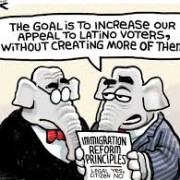
 Likewise, Millennials are more receptive to immigrants than are their elders. Nearly six-in-ten (58%) say immigrants strengthen the country, according to a 2009 Pew Research survey; just 43% of adults ages 30 and older agree.
The same pattern holds on a range of attitudes about nontraditional family arrangements, from mothers of young children working outside the home, to adults living together without being married, to more people of different races marrying each other. Millennials are more accepting than older generations of these more modern family arrangements, followed closely by Gen Xers. To be sure, acceptance does not in all cases translate into outright approval. But it does mean Millennials disapprove less. (See chapter 6 in the full report)
A Gentler Generation Gap
A 1969 Gallup survey, taken near the height of the social and political upheavals of that turbulent decade, found that 74% of the public believed there was a “generation gap” in American society. Surprisingly, when that same question was asked in a Pew Research Center survey last year — in an era marked by hard economic times but little if any overt age-based social tension — the share of the public saying there was a generation gap had risen slightly to 79%.
 But as the 2009 results also make clear, this modern generation gap is a much more benign affair than the one that cast a shadow over the 1960s. The public says this one is mostly about the different ways that old and young use technology — and relatively few people see that gap as a source of conflict. Indeed, only about a quarter of the respondents in the 2009 survey said they see big conflicts between young and old in America. Many more see conflicts between immigrants and the native born, between rich and poor, and between black and whites.
There is one generation gap that has widened notably in recent years. It has to do with satisfaction over the state of the nation. In recent decades the young have always tended to be a bit more upbeat than their elders on this key measure, but the gap is wider now than it has been in at least twenty years. Some 41% of Millennials say they are satisfied with the way things are going in the country, compared with just 26% of those ages 30 and older. Whatever toll a recession, a housing crisis, a financial meltdown and a pair of wars may have taken on the national psyche in the past few years, it appears to have hit the old harder than the young. (See chapter 3 in the full report)
But this speaks to a difference in outlook and attitude; it’s not a source of conflict or tension. As they make their way into adulthood, Millennials have already distinguished themselves as a generation that gets along well with others, especially their elders. For a nation whose population is rapidly going gray, that could prove to be a most welcome character trait.
Source: Pew Research Center



Good article. I especially liked the overall generational comparisons that were presented as well as the side by sides in behavior and belief systems. I keep telling Boomers (when I hear them complaining about youth) that Millennials are not only sharper but much more open minded to their world and to change. Of course most of that is through necessity, it’s a survival skill, but they’re innately good at it.
Thanks for posting!