


Customer experience and sentiment analysis
The notion that listening to your customer’s voice is important is firmly established. Companies have depended for a long time on data from customer surveys, call center transcripts and focus groups. This data was captured in a structured format and visualized via charts or processed with the help of business intelligence applications, to help identify how to improve customer service, develop or improve products and pinpoint competitor vulnerabilities.
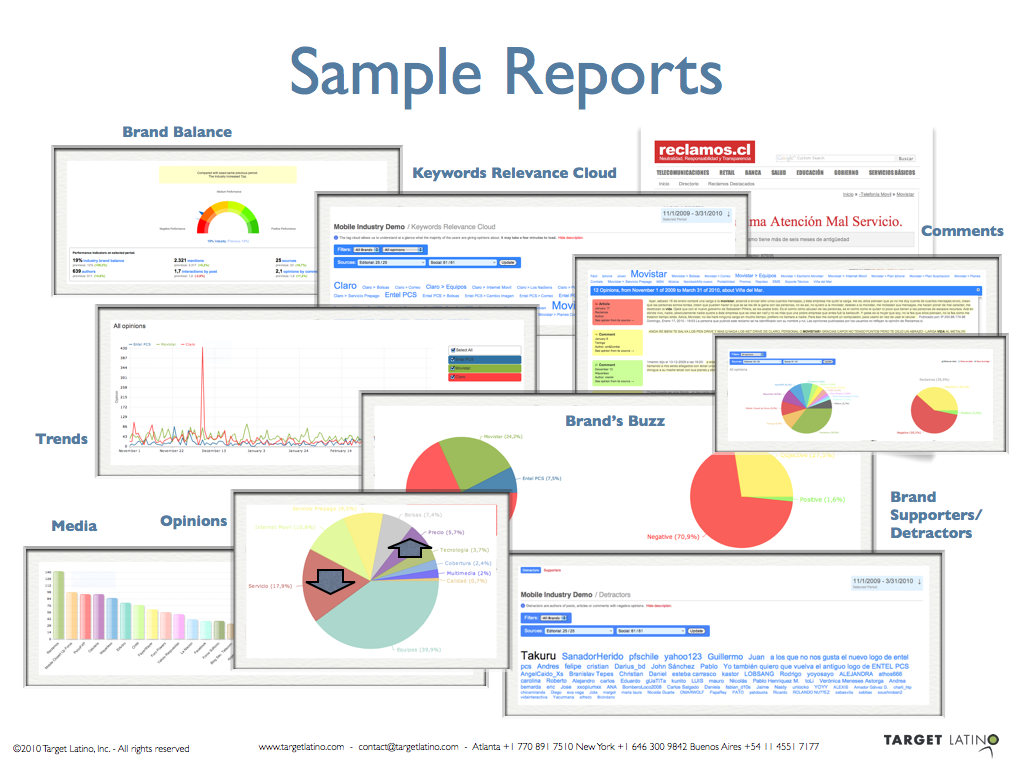
Companies face a very real need not just to acknowledge the impact of unstructured social media on brand and product perception, but to understand and filter it sensibly, and to integrate it with structured customer data and get it into the hands of the right people to make it actionable.
But the veritable volume of the customer voices in the Web 2.0 age more often than not leaves companies struggling to keep up. Now people have a voice and a tendency to express their opinions with blunt honesty via blogs, tweets, e-mails and forums about products and services that they find gratifying or disappointing. And those opinions hold weight. A 2007 study by Jupiter Research (now Forrester), called “Social Networking Sites: Defining Advertising Opportunities in a Competitive Landscape,” found that 30% of frequent social networkers trust their peers’ opinions when making a major purchase decision, compared to the 10 percent who trust advertisements.
As Andreas Wiegend, former chief scientist of Amazon.com, predicted in a blog post for the Monitor Talent Group, “In 2009, more data will be generated by individuals than in the entire history of mankind through 2008.” Companies face a very real need not just to acknowledge the impact of unstructured social media on brand and product perception, but to understand and filter it sensibly, and to integrate it with structured customer data and get it into the hands of the right people to make it actionable.
For many companies, the burgeoning text analytics approach of sentiment analysis is becoming a critical component of their overall strategy, giving them a much-needed assist to stay responsive to customers, market opportunities and trends.
What is it?
In his white paper “Text Analytics 2009,” Seth Grimes, analytics strategist at Alta Plana, describes text analytics as “the software and the transformational steps that discover business value in ‘unstructured’ text.”
There’s special business value in discerning opinion, sentiment and subjectivity—the “voice of the customer”—in text as varied as blogs, forum postings, articles, e-mail and survey responses. That field of “customer experience analysis” applies sentiment analysis and other techniques to understand and help predict consumer behavior via text analysis coupled with analysis of customer transactions, profiles and demographics.
Vendors generally use a combination of statistical analysis of word frequency andco-occurrences with linguistics (involving lexicons, dictionaries and language rules) in an algorithmic approach to understanding exactly what the consumer is saying. Grimes says, “The narrower you can frame the problem and the data you collect, the better, because you can then adjust your approach to match specific business requirements and information sources.”
The technological challenges are not for the faint-hearted or the linguistically timid. Suresh Vittal, analyst at Forrester, says, “For a long time, text analytics was a technology in search of a business need. Now, thanks to social media, the need is there; the question is whether the technology can ramp up fast enough to be commercial.” Early adoption by government agencies, which sought to apply text mining to mountains of classified documents, is giving way to more mainstream commercial demand from industries for whom customer perception is critical: hospitality, consumer brands and high-tech, among them.
Classifying the messy middle
Ours is a world in which online consumer reviews of hotels that might include the phrase “the lobby is baaaaad!” meant in a positive way, or a review of a holiday toy saying, “I would give this to all the children in my life, if I were Scrooge,” meant to disparage. Throw in slang, language evolution and socio-cultural gradations in word use, and you have a mammoth challenge for accurate computational treatment of opinion.
Levy says accuracy remains a challenge in the industry. “The sentiment side is good at the two poles, positive and negative. But the neutrals are difficult. If you give four people in a room 100 neutral opinions and ask them to classify, even they will only agree 55 to 60 percent of the time.”
The level of granularity can also be important. If sentiment is assigned at a document level—that is, each tweet or blog post is assigned a positive, neutral or negative sentiment—how does the hypothetical tweet “I love Marriott’s bathrooms but the beds are lumpy” get classified? A chief executive officer cautions, “Ratings need to be assigned on a subject level at a minimum; a solution that assigns them at a document level is going to miss something.”
Whose opinion is it?
Even if a sentiment analysis tool were always accurate, the opinions don’t necessarily carry equal weight. Dell has an estimated 8,000 to 10,000 online conversations about its brand each day, which span the spectrum of positive to negative; the company needs to understand whose opinion actually has the power to move brand perception, and keep close tabs on those. Sentiment analysis needs to be connected to social metrics and influence analysis to make sense.
Levy agrees, saying companies understand that listening to social media is important but now need help in filtering. “There is no longer the notion that trusted information only comes from The New York Times,” he says. “Once you get a handle on who is influencing your brand, that becomes actionable.” Influence analysis, analyzing digital breadcrumbs to see which individuals have the highest credibility and widest reach, should be a part of the overall text analytics strategy. By knowing in advance who the influencers are for your brand, you’ll be better prepared to manage crisis and opportunity effectively, reaching out to 20 key contacts instead of 10,000 questionable ones.
Taking sentiment out of the silo
There’s widespread agreement among vendors and analysts that text analysis is only as valuable as the actions it prompts. In a Forrester report from February 2009, called “Obstacles To Customer Experience Success,” a survey of 90 customer experience decision-makers from large North American firms found that 89 percent said that customer experience would be either very important or critical to their 2009 efforts, but a lack of cooperation across organizations remains a major obstacle.
When it comes to sentiment analysis, different functions are listening for different answers. A customer service manager needs insight into customer experience, a product manager wants to hear complaints or praise for features as well as product design ideas, and brand managers may be looking for competitive intelligence.
For customers of online monitoring solutions, acting on the feed of information is the hardest part of the equation. You must have an environment where people are culturally attuned to action.
The challenge to the enterprise is to combine analysis of what is being said, by whom, with more structured customer intelligence data in order to develop a robust customer engagement strategy. Forrester’s Vittal says that to break sentiment analysis out of the silo, “The platforms must be open and integratable. Customer intelligence data is still siloed, and there is a complexity gap that must be overcome.”
Companies should combine unstructured data from opinions about their brands and products, posted on social media and other traditional online sites, with public opinion as measured through structured survey research, to paint a richer picture of consumers’ emotions and decision factors.
Getting started
For companies that are just getting started with sentiment analysis, the first step is to listen to what’s being said, analyze the information and identify possible root causes behind it—a company can truly begin to capitalize on the promise of text analytics- and use it as input to their marketing strategy.



Trackbacks & Pingbacks
[…] problems for people who talk about you, even if they don’t address you. (Listen to the conversation and […]
[…] problems for people who talk about you, even if they don’t address you. (Listen to the conversation and […]
[…] More here: Customer experience and sentiment analysis | Hispanic Marketing Blog […]
Twitter Comment
Making the case for social media monitoring and analysis -> Customer experience and sentiment analysis [link to post]
[…] This post was mentioned on Twitter by claudia havi goffan, claudia havi goffan and claudia havi goffan, Jennie Barker. Jennie Barker said: RT @TargetLatino – Customer experience and sentiment analysis http://ht.ly/1T2Ja #socialmedia #onlinemarketing […]
Leave a Reply
Want to join the discussion?Feel free to contribute!